Marble is a calcium carbonate-based metamorphic rock, and that chemistry matters when selecting a bonding agent. The same adhesive that performs reliably on dense black granite can bleach, stain, or fail to cure properly when applied to a white Carrara slab with higher porosity. Marble glue selection is not simply about bond strength, it is about chemical compatibility, working time, color neutrality, and resistance to the specific stresses the installation will face over its service life.
Professionals working with natural stone frequently reference ASTM C482, the standard test method for bond strength of ceramic tile to portland cement paste, as a baseline framework, even though marble installations often rely on epoxy or polyester systems instead of cement. The stress analysis concepts transfer directly.
Three adhesive families dominate marble installation work:
Epoxy adhesives offer exceptional bond strength, chemical resistance, and gap-filling capability. Two-component systems require mixing a resin with a hardener at a precise ratio. Pot life is limited, typically 20 to 45 minutes at room temperature, so the working window demands efficiency. Epoxy is the go-to for marble repairs, countertop joint filling, and installations where the substrate is irregular or the slab carries structural load.
Polyester-based adhesives cure faster and are significantly more affordable than epoxy. They are widely used for color-matched repairs and for laminating marble slabs in fabrication settings. The main limitation is UV sensitivity: polyester can yellow over time in sunlit environments, which makes it unsuitable for window surrounds or exterior ledges in high-UV climates.
Cementitious tile adhesives are appropriate for marble tile installations where the substrate is concrete or cement board and the marble thickness is within standard tile dimensions. For slabs exceeding 15 mm thickness or panels larger than 600 x 600 mm, professional practice generally shifts toward epoxy or dedicated stone-setting mortars.
| Adhesive Type | Bond Strength | Working Time | UV Resistance | Best For |
|---|---|---|---|---|
| Two-part epoxy | Very high | 20-45 min | Good | Repairs, structural joints, countertops |
| Polyester resin | High | 10-20 min | Poor to moderate | Color repairs, lamination in fabrication |
| White cementitious adhesive | Medium-high | 30-60 min | Excellent | Floor tiles, wall tiles (standard size) |
| MS polymer adhesive | Medium | 30-90 min | Good | Flexible joints, facade cladding |
This is where projects go visibly wrong when someone picks the wrong product. Marble, especially light-colored varieties, is translucent at the surface. Adhesive color bleeds through. White Carrara, crema marfil, and similar light stones require a white or off-white adhesive. Darker stones like nero marquina or emperor dark can tolerate gray-toned adhesives, and in some cases the tonal match actually improves joint aesthetics.
Epoxy adhesives can be tinted with pigment pastes at the mixing stage. This is standard practice in premium stonework: the fabricator mixes the adhesive to match the stone's background tone before filling hairline joints or setting trim pieces. Getting the color match right on the first attempt requires a test patch on a scrap piece of the same stone batch.
High-porosity marble, common in some Italian and Turkish varieties, absorbs liquid adhesives quickly during open time. This affects both the working window and the final bond quality. A penetrating stone sealer applied before adhesive work reduces absorption rate and gives the installer more control over the bonding process. The sealer must be compatible with the adhesive chemistry, however: silicone-based sealers can interfere with epoxy adhesion, for example.
Surface preparation rules are universal regardless of adhesive type: clean, dry, dust-free, and free of release agents. A marble slab pulled from a pallet often has surface contamination from factory processing. Wiping with a clean solvent cloth before adhesive application costs very little time and prevents a significant percentage of adhesion failures.
During a renovation of a heritage hotel property in Guangzhou, the stonework contractor faced a classic problem: existing white carrara marble countertops had multiple hairline cracks and a displaced slab joint that needed repair without full replacement. The team selected a two-component epoxy adhesive tinted to match the carrara's warm gray veining. Working time was managed by mixing in small batches and keeping the adhesive cool. The result was a repair that was invisible at normal viewing distance and passed the client's sheen-matching inspection. Total material cost for the repair was a fraction of slab replacement.
Adhesive selection affects not just installation day performance but long-term behavior. Thermal cycling in exterior marble cladding applications stresses joints repeatedly. Adhesives with a degree of flexibility, such as MS polymer or modified epoxy systems, handle this better than rigid polyester. For wet areas like shower surrounds, the adhesive must maintain bond strength in continuously wet conditions, which typically means a certified waterproof epoxy or a cement-based system with waterproofing additives.
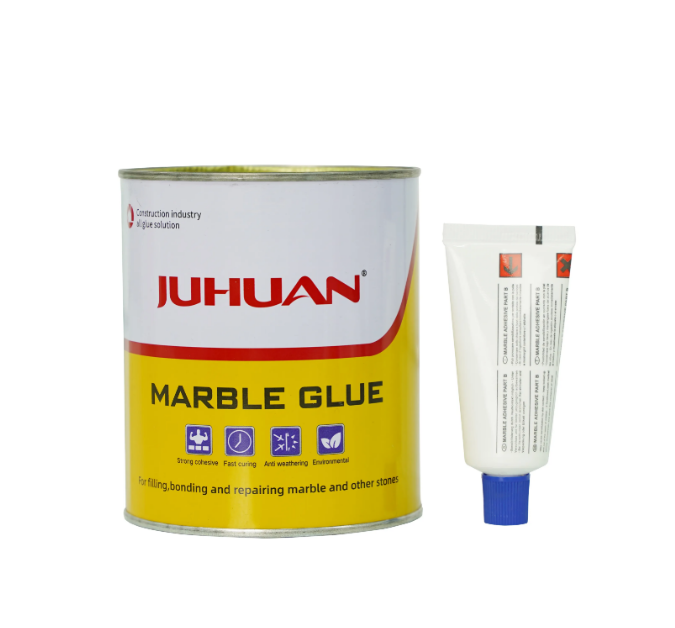
For stone fabricators and installation contractors looking for adhesive products with consistent color performance and reliable cure behavior, JUHUAN's marble glue and stone adhesive range provides formulation options suited to both repair work and new installation requirements.
 Hot News
2026-07-01
2026-06-18
2026-06-04
2026-05-16
2026-05-06
2026-04-29
Copyright © 2025 by Shandong Juhuan New Material Technology Co., Ltd. - Privacy policy
 EN
EN