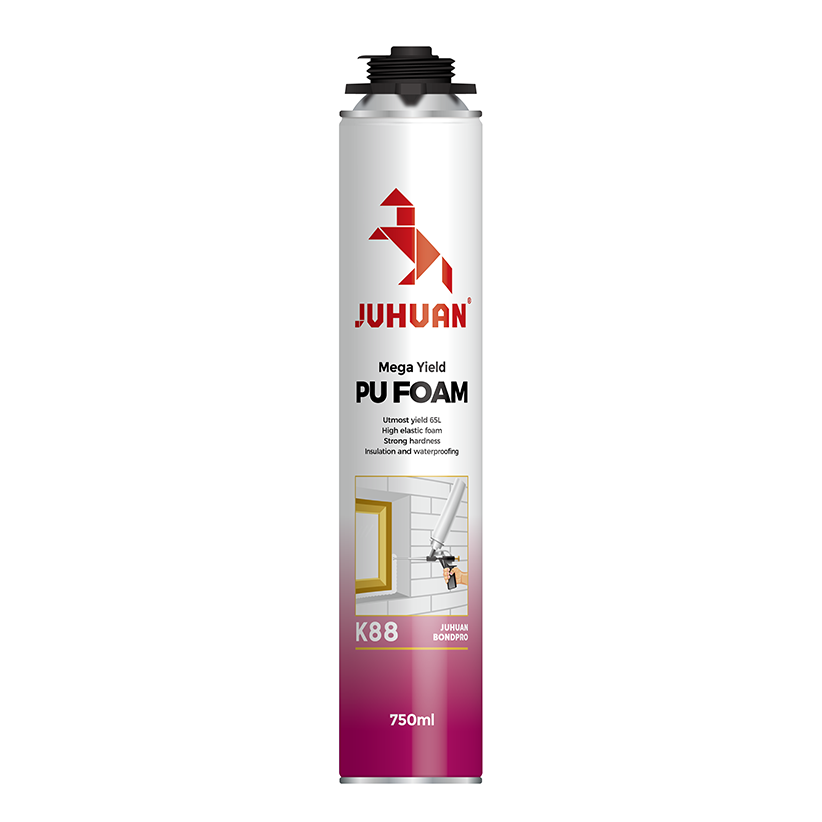
At its core, pu foam is an incredible insulator because it tackles heat transfer on three separate fronts at the same time. Heat always wants to move from a warm area to a cold area, and it has three main ways to get there: conduction through solid materials, convection through moving air or liquid, and radiation through electromagnetic waves. Most insulation materials do a decent job with one or two of these, but PU foam has a unique combination of properties that allows it to fight back against all three with remarkable efficiency. The real secret lies in what happens the moment you pull that trigger. When the liquid components inside the can mix and react, they create a chemical reaction that generates heat and releases carbon dioxide gas. This gas gets trapped in millions upon millions of tiny bubbles, and as the foam expands and cures, those bubbles become permanent, sealed chambers. It's not just about filling space. It's about creating a physical barrier that heat really doesn't want to cross. When you understand this, you start to see why simply stuffing fiberglass batts into a wall cavity will never match the performance of a properly applied foam seal.
If you want to understand why PU foam is such a thermal superstar, you have to zoom in and look at its microscopic structure. Under a microscope, high quality PU foam looks like a dense honeycomb, a network of tiny, individual cells with walls made of solid polyurethane polymer. The defining characteristic here is that the vast majority of these cells are "closed." That means each tiny bubble is a self contained pocket, completely surrounded by polymer walls and sealed off from its neighbors. This closed cell structure is the foundation of everything that makes this material great at insulating. Because the cells are sealed, air cannot move freely through the foam. Convection, which is a major heat thief in fluffy fiberglass or open cell materials, is effectively shut down. The gas inside those cells just sits there, unable to circulate and carry warmth away.
But the structure is only half the story. The other half is the gas trapped inside those cells. The blowing agents used to create the foam, which can include carbon dioxide, pentane, or cyclopentane, are significantly worse conductors of heat than regular air. When you measure how easily a material lets heat pass through it, you're looking at its thermal conductivity, often represented by the Greek letter lambda (λ). The lower that number, the better the insulator. Regular air has a thermal conductivity that gives typical fiberglass or cellulose an R-value per inch in the low to mid 3s. PU foam, on the other hand, typically clocks in with a thermal conductivity of about 0.024 W/m·K, which translates to an R-value per inch of around R-6 to R-7, nearly double that of many conventional options. That means you get the same insulating power with half the thickness, which is a huge advantage in tight spaces like window frames or door jambs. The combination of a fine, closed cell foam structure and these low conductivity cell gases is what gives rigid PU foam its superior thermal performance.
It's one thing to have a material with great numbers on a lab report, but it's another thing entirely for that material to perform in the messy, irregular world of real construction. This is where pu foam truly separates itself from the pack. Traditional insulation like fiberglass batts or rigid foam boards are fantastic for covering large, flat, open areas, but they are terrible at dealing with the complicated little spaces where heat loves to escape. Think about the gap between a window frame and the rough opening in the wall, the hole where a pipe or electrical wire passes through the floor, or the irregular cracks and seams where walls meet ceilings. If you've ever tried to stuff fiberglass into a gap around a window, you know it's a losing battle. You either compress it too much and ruin its insulating ability, or you leave little voids that act as invisible highways for air leakage.
PU foam solves this problem by literally becoming the perfect shape for whatever void it's applied to. Because it's applied as a liquid that then expands, it flows into every nook, cranny, and irregular surface, adhering tightly to the surrounding materials and creating a monolithic, airtight seal. This ability to conform and fill voids uniformly is what makes it indispensable for installing doors and windows, sealing pipe penetrations, and insulating hard to reach areas like roof edges and foundation cracks. When you eliminate those tiny air leaks, you're not just stopping a draft. You're stopping the convective loop that pulls conditioned air out of your building and replaces it with outside air that your HVAC system then has to work harder to heat or cool. This airtight sealing is often where the biggest energy savings come from, because air leakage can account for a substantial portion of a building's total heating and cooling load. A can of foam applied to the right spots can have a surprisingly large impact on your monthly utility bill.
One of the common questions people have about any insulation material is whether it will still be doing its job ten or twenty years down the road. Some materials settle over time, some absorb moisture and lose their effectiveness, and some simply degrade. With closed cell PU foam, the long term outlook is remarkably positive. Studies have shown that polyurethane rigid foam has a useful life of 50 years and more, and it maintains its very low thermal conductivity over that entire period. This is largely due to that closed cell structure we talked about earlier. Because the cells are sealed, they act as a barrier against moisture ingress. The foam does not soak up water like a sponge, so it won't become a soggy, ineffective mass or a breeding ground for mold.
There is a phenomenon known as "foam aging" where the thermal conductivity of the foam will increase very slightly over time as the low conductivity blowing gases slowly diffuse out and are replaced by regular air. However, this is a slow process that is well understood by engineers and is already factored into the long term performance ratings used in building codes. In practical terms, a foam insulated wall or window frame will perform at a high level for the entire lifespan of a typical building. Samples taken from a pitched roof in Germany after 28 years in service showed no damage, no holes, and no loss of performance. The thermal conductivity measured after nearly three decades was actually slightly better than the originally declared value. When you compare this kind of durability to fiberglass batts that can slump and leave gaps at the top of a wall cavity, or to cellulose that can settle and compact over time, the advantage of a rigid, permanently adhered foam becomes crystal clear. It's an investment that continues to pay dividends in energy savings and comfort year after year, decade after decade.
 Hot News
2026-07-01
2026-06-18
2026-06-04
2026-05-16
2026-05-06
2026-04-29
Copyright © 2025 by Shandong Juhuan New Material Technology Co., Ltd. - Privacy policy
 EN
EN