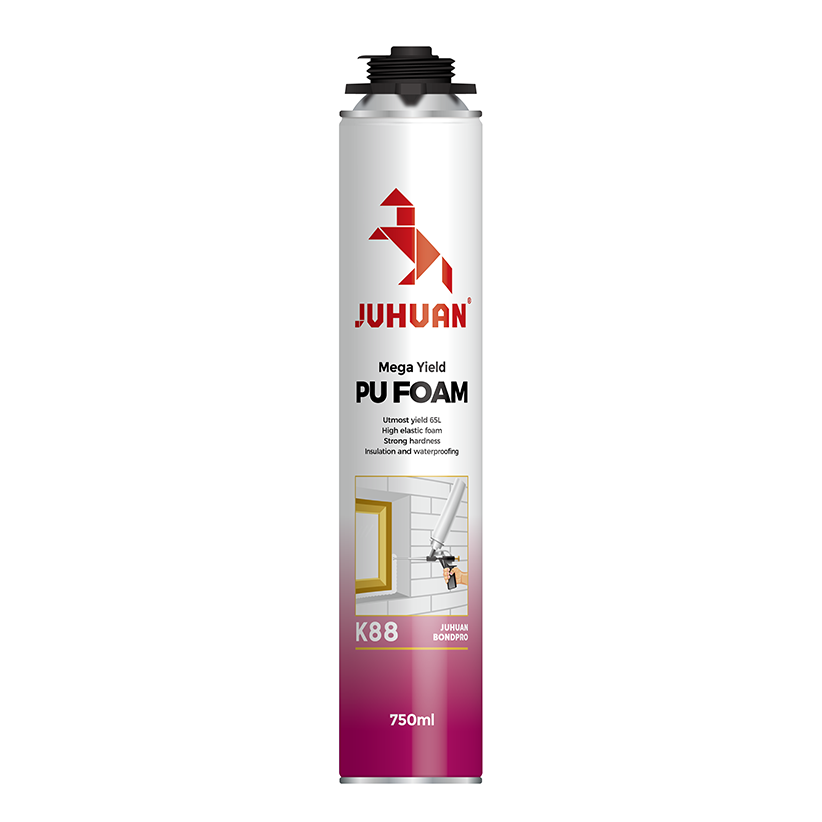
Have you ever lived in an apartment with noisy neighbors? Or in a house near a busy road? If you have, you know how annoying noise pollution can be. It can make it hard to sleep and concentrate and can lower your quality of life. People often think soundproofing has to be expensive, and think of things like soundproof panels and soundproofing drywall. But there are cheaper options. There are cheaper and more versatile options. One of those options is PU foam. Most likely you know PU foam as the stuff that expands out of a can. But it is a great solution for noise problems. Companies, like Juhuan, have been making PU foam for over thirty years, and in those thirty years they have learned to make PU foam for many uses, including making spaces quieter. Let us look at why PU foam is such a good choice for your soundproofing projects.
We know that noises can be heard from outside of our homes. Walls are not the only thing that noise travels through. The tiniest cracks and openings are often the greatest source of annoying sounds. When you look around the room you are in, you will probably see the gaps around the window and door frames, and where pipes or wires come through the walls. These gaps are like highways for sound. You might be surprised how much noise is transmitted through even the tiniest of openings.
The strongest feature of PU foam is its ability to fill every gap in an opening. When PU foam is applied to an opening, it expands to fill every nook and cranny and makes a solid, airtight, noise blocking seal to fill those sound ways. When you fill the gaps around your doors and window frames, as stated in the application list of the Juhuan website, you will be blocking one of the most important culprits of noise pollution in a room. This may sound like a simple act, and that is true, but it will be one of the most important acts that you can do to reduce the noise in any room.
PU foam does more than just close openings. It also helps with the physical properties of sound. Sound travels through the air in waves. When the waves contact a hard, flat surface such as a wall, they reflect off of it. This bouncing creates echo and reverberation, which increases the noise.
PU foam, particularly when it is completely cured, has a more unique structure. It consists of millions of tiny cells that connect to one another. It is like a rigid sponge. When sound waves come into contact with this kind of structure, they become trapped in the material. The energy of sound waves is transformed into tiny pockets of heat as they bounce around inside the foam. This is known as sound absorption. It decreases the sound energy that can be transmitted through a wall or reflected into a room. This is the reason PU foam is used in window and door applications as well as around seals to make a home quieter.
The foam increases the structure sound blocking capability by adding mass and damping. Mass is good for soundproofing. Thick walls are better than thin walls for blocking sound. When foam is injected into the cavity of a wall or the frame of a door, the empty space is filled with a solid material.
With the addition of foam, the ability to transmit sound is reduced. The foam adds mass to the structure, making it more difficult for sound to travel. The foam has a damping effect. It absorbs some of the vibrational energy that would otherwise cause the wall panels to vibrate and transmit sound. Therefore, using PU foam, as described in the product applications, helps to turn a hollow, sound transmitting structure into a more solid and quieter one.
Sound travels not only through the air. It travels through solid materials. This is called structure borne noise. When someone walks heavily on the floors, it can be heard as loud thumps through the ceiling. That is structure borne sound.
PU foam can help interrupt vibrations and sound paths. Because it remains flexible once cured, it can act as a decoupler. For example, when used around a door or window frame, it can create a flexible seal between the frame and the wall. This can help prevent vibrations or sound from being transferred directly. It also helps seal flanking paths, which are indirect routes sound can take. This is done by filling and sealing gaps as continuously as possible to ensure sound transmission is blocked around your soundproofing efforts.
PU foam is a great soundproofing material and its characteristic of becoming a solid yet flexible foam makes it perfect for many soundproofing applications. It can be used anywhere from new construction, where it is great to use it to seal around window and door installations, to renovation projects where you can use it to fill gaps in existing walls or around retrofit windows.
On the Juhuan site, they mention some uses for the foam: installing doors and windows, insulating houses, and beautifying home decorations. All of these uses also have a soundproofing angle. An insulated house also has better soundproofing. During a decorating project, sealing gaps stops sound from entering through new fixtures. This makes PU foam especially handy for soundproofing whether you are a contractor or a DIYer.
When you are putting any materials into the walls of your home, safety is a top concern. You do not want to have any materials that could catch fire easily and turn your soundproofing project into a hazard. This is another area where modern PU foam excels.
Specialized formulations to solve this problem have been created by manufacturers. Juhuan, for example, has a fire retardant polyurethane foam which has passed the national B1 level test. This means it has been tested and proven to have low fire ignitability and also to help slow the spread of a fire. Therefore, if you use PU foam to soundproof your house, you will not be compromising safety. It will also provide you with the added peace of mind knowing it will help keep your house safe from the spread of fire.
Often, soundproofing requires working in cramped or awkward areas, which are not always easy to access. These may include the gaps around windows and the areas behind electrical outlets. It is also common to have trouble getting insulation or acoustic sealant into those areas when you are trying to soundproof.
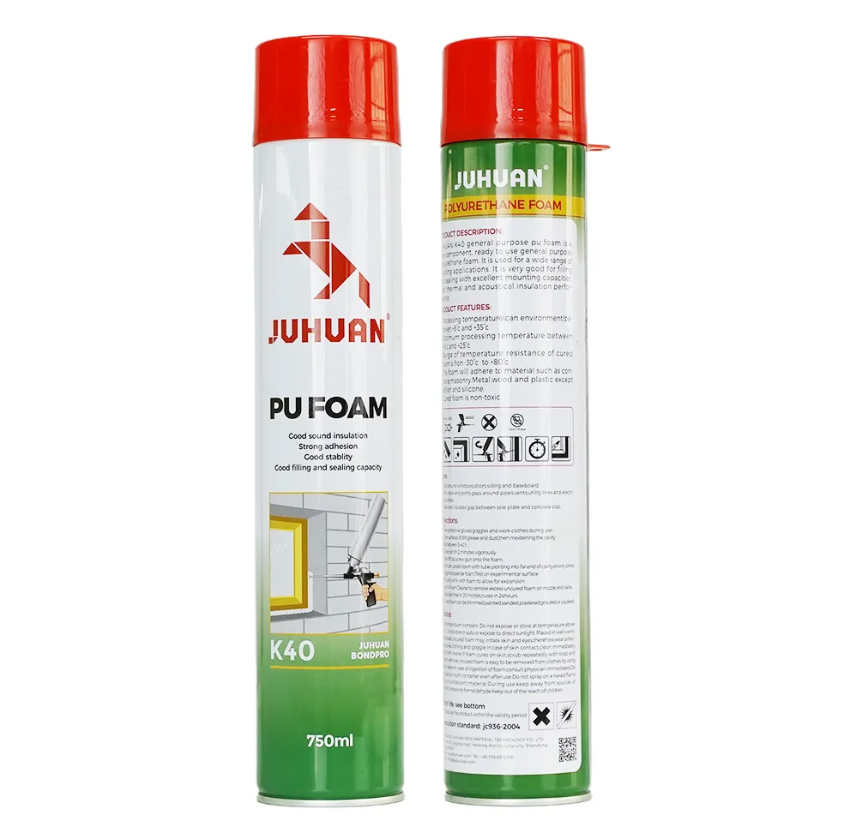
PU foam is most useful in these situations. It comes in an aerosol can with a straw applicator that allows easy access to fill very narrow gaps. With PU foam, you do not need to trim or adjust pieces to fit. PU foam is user friendly. The more user friendly a product is, the more likely it is that the user will take the time to use it properly. This is a very positive thing, as the more thoroughly the foam is used to seal gaps, the more likely it is to provide the desired improvement in soundproofing.
Now let us take a look at the cost. Soundproofing can be very expensive. This is due to the cost of the materials, as well as the cost of the time, or labor, it takes to install them. Some of these materials include acoustic panels, special types of drywall, and mass loaded vinyl.
Using PU foam as a sealant can provide a very worthy alternative or addition. PU foam has a very low cost and a single can can seal a large number of gaps. When gaps around the frames of windows and doors are sealed using PU foam, the improvement in sound insulation is very noticeable. PU foam is a very good soundproofing product, and the cost to use it is very low.
Why is PU foam a good choice for soundproofing? Because it works. It fills small cracks and gaps where sound leaks in, adds mass and damping to hollow walls and frames, and prevents vibrations from continuing through the structure. It is also really easy to use and ultra affordable. You can even get fire retardant options, so it is safe to use in your house. For your soundproofing needs, PU foam from Juhuan, backed by decades of experience, offers the reliability you need. As a first step in soundproofing your home or office, PU foam is awesome.
 Hot News
2026-07-01
2026-06-18
2026-06-04
2026-05-16
2026-05-06
2026-04-29
Copyright © 2025 by Shandong Juhuan New Material Technology Co., Ltd. - Privacy policy
 EN
EN