Commerical buildings are complex structures. They must have the right combination of insulation, building materials, and design to keep occupants safe and reduce risks. Fire retardant Polyurethane foam is an insulator and an excellent sealer, but also adds to the foam's ability to enhance the fire safety of the building. This article looks at some of the benefits of fire retardant polyurethane foam and why it is a preferred option in many construction projects.
Fire retardant polyurethane foam is a specialized foam that is able to resist sparks and slow down the fire spreading. Fire retardant PU foam is different from conventional PU foams which are flameable. Fire retardant polyurethane foam has been modified to allow it to withstand high temperatures and also produces lower levels of toxic smoke. For instance, rigid polyurethane foam (RPUF) is considered to have a low limiting oxygen index (LOI) because it is easy to burn and is around 19.5%. Flame retardant treatment, however, 3can increase the LOI to over 31.5% and this foam is able to meet the fire safety regulations such as UL-94 V-0.
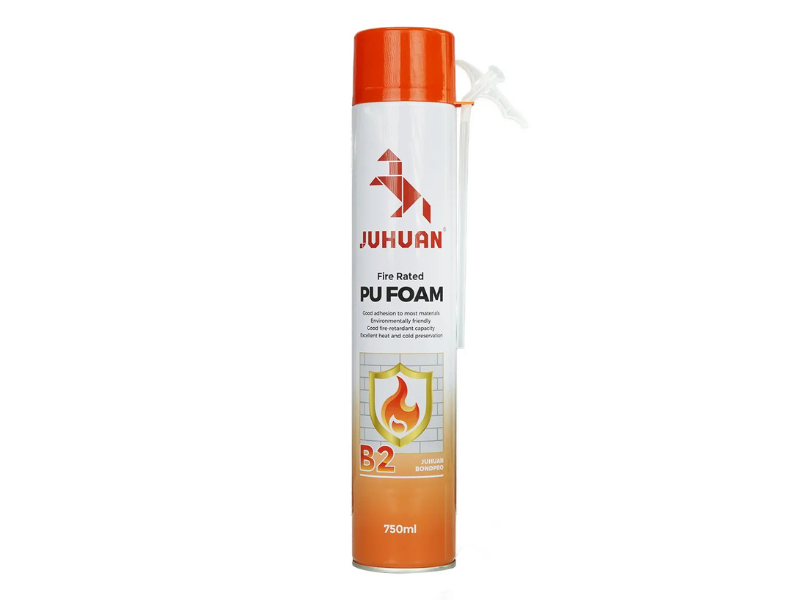
The fire-retardant PU foam is self-extinguishing. The foam, when coming into contact with flame, forms a protective char layer that prevents further burning and further toxic gas releases. Phosphorus-nitrogen synergy or intumescent coatings that expand when heated and create a barrier between fire and material are the methods used. Products such as JUHUAN B2 fire-rated PU foam are created with the property of self-extinguishing, making them well suited to fill voids in high-risk places, such as fire-rated electrical conduits, HVAC systems, and more, where the potential of a fire starting is significant.
Building fires are a major threat to safety and property and high-rise fires alone claim thousands of lives and cause millions of dollars in damage every year. Standard insulation materials such as expanded polystyrene (EPS) or mineral wool are also used, even though they have their weaknesses. EPS emits toxic gases and melts quickly, while mineral wool has a high thermal efficiency. The bottom line is that fire-retardant PU foam has excellent insulation properties and combines that with enhanced fire resistance, which is a rare combination.
Its closed-cell structure achieves over 90% closed cells, hindering heat transmission and consequently reducing the rate at which temperature increases during a fire scenario. Additionally, this dual functionality meets the energy efficiency and safety standards simaltaneously. Furthermore, modern construction industry regulations have continued to be more and more compliant and restrictive to materials using standards like EN 13501-2 or GB/T 50404-2007 which evaluate flame spread, smoke density, and toxicity. Fire-retardant PU foam complies with these industry standards ensuring consistency over reliability for these industry applications.
Thermal conductivity of PU foam, with a range of 0.023–0.0415 W/(m·K) is extremely low. Because of this, PU foam is able to achieve the same insulation effect with significantly less thickness when compared to other materials. As an example, the insulation depth of 50 mm of PU foam is equivalent to 80 mm of EPS or 90 mm of mineral wool. What this does is help in reducing energy consumption by ensuring the thermal comfort of a building is sustained.
Fire-retardant PU foam showcase the same mechanical properties of flexibility and durability that other PU foams have. It has high compressive strength (up to 486 kPa) and good adherence which means that it can withstand movements of the structure without cracking. Long term reliability in the sealing of joints and gaps is ensured by products like JUHUAN B2 foam which resist shape loss over time.
When it comes to PU foam, fire-retardant formulations improve fire resistance through chemical modification and fire-retardant coatings. For example, sulfur-based polymers can increase the LOI towards 36.4%. phosphorous systems can mitigate the heat release rates to lower than 50 %. Moreover, modern formulations address the concern of fire emergencies, limiting the production of smoke and toxic gases.
The push for sustainability is also shaping the next generation of PU foam. We're now seeing exciting innovations where formulations are incorporating renewable feedstocks as alternatives to traditional fossil fuels. This approach significantly reduces the net greenhouse gas footprint of the product while maintaining all the expected performance benefits. On the fire-retardant side, the industry is moving toward more planet-friendly solutions, including water-based coatings that effectively eliminate the need for environmentally harmful halogenated compounds.
Due to its versatility, formulations of fire-retardant PU foam can be used in:
1. Sealing gaps and joints: it can fill in the voids of gaps around windows, doors and pipes to prevent the spread of fire and smoke.
2. Insulation for walls and roofs: its low thermal conductivity contributes to energy efficiency in the building
3. Industrial and cold storage facilities: These demanding environments rely on high-performance polyurethane foams that deliver both critical fire resistance and long-term thermal stability.
4. Retrofitting older buildings: it improves fire safety on pre-existing structures without adding greater weight or complexity.
Selecting the fire-retardant PU foam involves several key steps: Understanding the certifications. Accuracy of test results. Intended applications. Some of the major considerations include:
1. Fire ratings: Select only those with a B2 rating or those with more severe ratings because they have a self-extinguishing fire rating.
2. Environmental impact: Low GWP fire foams with no ODP should be the selected foams.
3. Compatibility: Find PU foams that have adhesion properties to major building materials like concrete, wood, and metal.
Further advancements will continue to be made with the fire-retardant PU foams along with improvements with the fire-retardant foams STEM fields. Nanocomposite coatings along with bio-based Polyols continue with the development of building materials with greater performance and safety along with increased sustainability. Also with the innovations of fire-retardant PU foams along with the innovations of building systems regulations, fire-retardant PU foams will continue to implement the formation and development of energy efficient building systems, along with the innovations of building materials to provide resistant systems to fire.
Fire-retardant PU foam building materials and construction systems provide safety and functionality. The fire-retardant insulation foam seals and eliminates the combinations PU foam provides and building construction materials add to the foam to construction materials add to the PU foam construction materials. Constructing and building with fire retardant quality foam systems provides builders and homeowners safety along with ease, peace with constructions and foam systems, along with the construction of energy efficient building systems.
Building with the quality materials fire retardant PU foams provides will, complete peace of mind. The foam will contribute the builders and homeowners more efficient systems. The materials continue to provide a quality construction and provide the systems.
 Hot News
2026-09-09
2026-07-01
2026-06-18
2026-06-04
2026-05-16
2026-05-06
Copyright © 2025 by Shandong Juhuan New Material Technology Co., Ltd. - Privacy policy
 EN
EN